
Competition in the premium MPV segment is intense, with no shortage of contenders. Yet most remain constrained by three enduring forces: brand premium, rigid product definitions and narrowly defined usage scenarios. In a market shaped by homogeneity, the industry may be in need of a genuinely different challenger. The question is whether the Geely Galaxy V900 could play that role.
In recent years, the high-end MPV market has become increasingly crowded. Model updates have accelerated, price competition has intensified, yet the underlying structure of the segment has proved remarkably resistant to change.
Imported models such as the Toyota Alphard and Lexus LM continue to serve as status symbols for Chinese consumers. Long-standing joint-venture players like the Buick GL8 still dominate the core business-use segment, backed by decades of brand accumulation. At the lower end, value-focused family MPVs struggle to cross the threshold into perceived luxury.
Even as domestic new-energy MPVs—such as the Denza D9, Wey Alpine and Voyah Dream—have gained traction, their impact has so far fallen short of fundamentally reshaping the market. Brand premium, product inertia and scenario lock-in remain formidable barriers for Chinese manufacturers seeking a breakthrough.
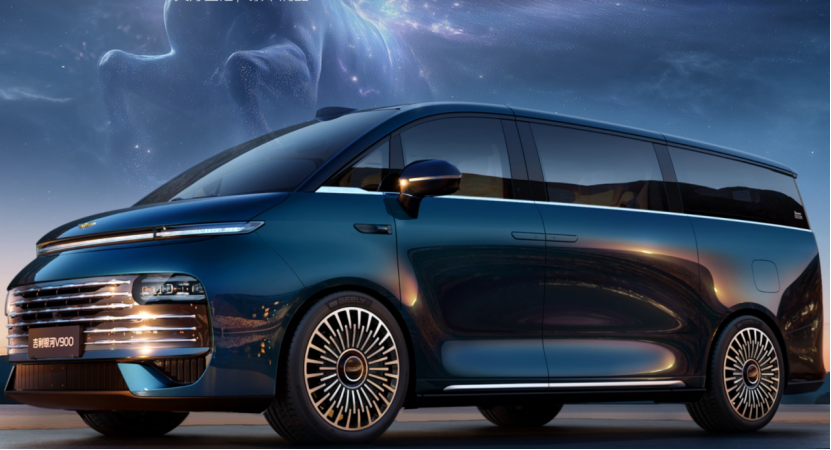
Against this backdrop, the arrival of the Geely Galaxy V900 has been met with cautious optimism. Backed by Geely’s industrial credentials and launched at a starting price of RMB 269,800, the V900 appears to be positioning itself as a direct challenger to the existing order. But does it truly have the potential to disrupt the premium MPV landscape?
Challenging Entrenched Perceptions
One of the biggest obstacles facing domestic brands in the premium MPV segment is not technological capability, but perception. Decades of dominance by joint-venture brands have cemented the idea that higher prices equate to higher status—a mindset that is difficult to dislodge.
That said, the shift is not impossible. As more Chinese brands enter the high-end MPV space, consumers are increasingly weighing tangible product value over brand premium alone. In other words, if the value proposition is strong enough, loyalty can shift.
The challenge is that many current high-end MPVs still operate under the same logic: “premium equals expensive”. The Buick GL8, for instance, has spent 26 years establishing itself as the business benchmark. Even with its PHEV version starting at RMB 249,900, mainstream configurations exceed RMB 300,000. Domestic competitors such as the Denza D9 and Wey Alpine are similarly positioned at the higher end of the price spectrum.
This reinforces the perception that the segment remains locked into a high-price mindset. Yet consumer expectations are changing. As buyers place greater emphasis on technology and overall value, brand barriers are beginning to weaken, nudging the market from a brand-led to a value-led orientation.
The Galaxy V900 enters at a moment when this transition is gathering pace. By attempting to redefine competition through a value-driven approach, it aligns itself with a broader shift in consumer thinking. The risks remain considerable, but the timing may be advantageous.
Rethinking the Product Definition
Breaking brand barriers is difficult; redefining product standards may be harder still. For years, the premium MPV segment has confined user expectations within a narrow framework—typically centred on space and comfort. While these attributes are undeniably important, widespread adoption has resulted in growing sameness.
Even the addition of features such as large screens, refrigerators and reclining seats has done little to create true differentiation, as nearly all major players now offer similar configurations.
As the market transitions towards value orientation, core demand is shifting from basic functionality to holistic experience. This requires not only sharper consumer insight, but also genuine technological innovation.
It is here that the Galaxy V900 seeks to distinguish itself. Built on Geely’s accumulated strengths in electrification and intelligent technologies, the V900 adopts a “technology-led redefinition” strategy.
In terms of dimensions, its 5,360mm length and 3,200mm wheelbase exceed those of key rivals such as the Denza D9 and Buick GL8, placing it closer to models like the Voyah Dream. An innovative vertically stacked range-extender layout delivers a reported space utilisation rate of 91.8%, with over one metre of longitudinal space in the second and third rows and a boot capacity exceeding 1,000 litres. Configurations for six, seven or eight seats are available, with the eight-seat variant addressing a notable gap in the segment.
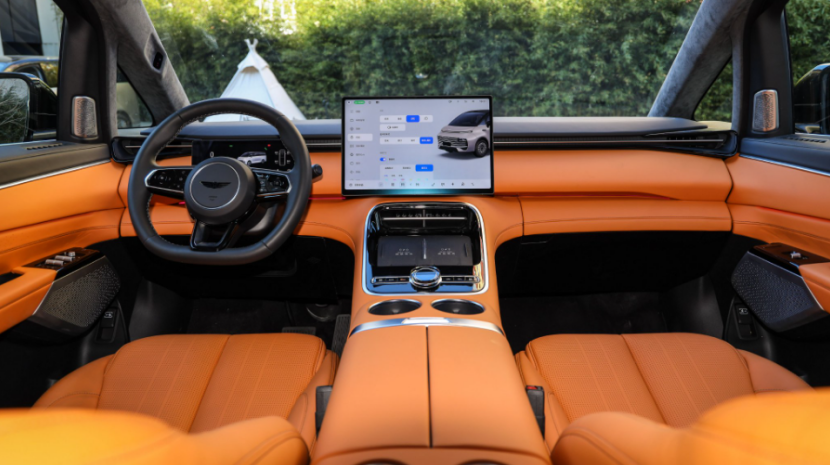
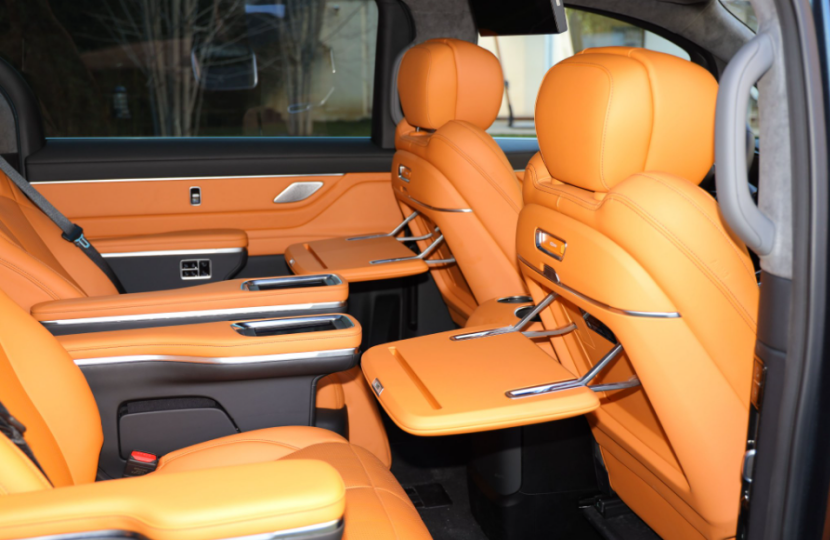
On the technology front, the V900 features Geely’s H5 assisted driving system, supported by lidar and high-performance computing chips, enabling full-scenario navigation assistance. The cabin integrates multi-screen interaction powered by the Snapdragon 8295P, alongside second-row zero-gravity massage seats, a 27-speaker audio system and a hot-and-cold storage compartment—balancing business and family use.
Safety and ride comfort are reinforced through a high-strength body structure, Geely’s Shield Battery, full-length side curtain airbags and an air suspension system tuned by Lotus. Power comes from a 1.5T dual-motor AI-assisted range-extender system producing up to 340kW, with a thermal efficiency of 47.26% and a strong focus on efficiency and range confidence.
Taken together, these elements form an “above-segment” package that aligns with the industry’s push towards technology-enabled differentiation. While many manufacturers remain focused on incremental feature stacking, the V900 attempts a broader redefinition across multiple dimensions.
From Scenario Lock-in to Scenario Integration
Beyond brand and product inertia lies a third barrier: rigid usage scenarios. For years, MPVs have been narrowly categorised—business vehicles on one side, family cars on the other.
The Buick GL8 is closely associated with official and corporate transport, while models such as the Denza D9 and Wey Alpine position themselves as “family-plus-light-business” solutions. In practice, this reinforces rather than challenges scenario boundaries.
Yet consumer needs are evolving. As households and small businesses seek greater flexibility, demand is shifting towards “one car, multiple roles”. Overly rigid assumptions about vehicle usage are becoming less relevant.
The Galaxy V900 appears to have identified this gap. Positioned as an “AI-powered, all-scenario flagship family MPV”, it aims to integrate business, family and long-distance travel into a single product concept.
This approach is reflected in its design and feature set. For business use, the second-row zero-gravity seats, multi-screen collaboration and competitive pricing appeal to cost-conscious small and medium-sized enterprises, while four-wheel drive enhances travel stability. For families, flexible seating layouts, roof-mounted displays, enhanced audio systems and generous third-row space improve everyday usability. For travel, a pure-electric range of 260km suits short trips, while a combined range of up to 1,220km reduces long-distance anxiety and operating costs.
That said, scenario reconstruction is not without challenges. Product versatility alone may not be sufficient. In the premium MPV segment, service ecosystems and institutional channels play a critical role—an advantage long enjoyed by the Buick GL8 through its nationwide corporate network.
Competitors such as the Denza D9 and Voyah Dream are also building tailored service ecosystems. For the Galaxy V900, leveraging Geely’s existing channels to develop a comprehensive, all-scenario service network will be essential if it is to translate product ambition into sustained market success.
Conclusion
Breaking through entrenched market barriers is easier said than done. The structural challenges facing China’s premium MPV ambitions have long served as comfort zones for foreign brands and formidable hurdles for domestic players.
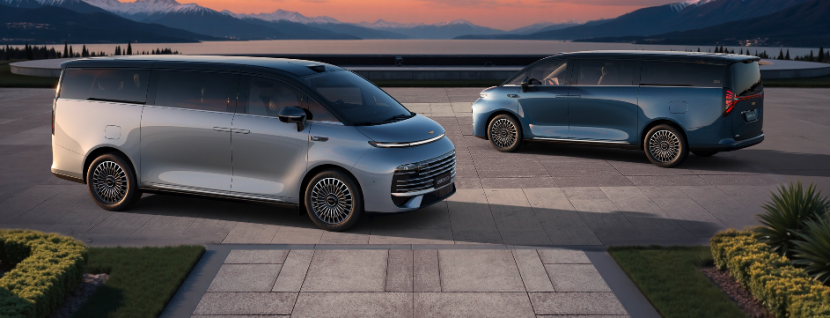
The Galaxy V900 represents Geely’s response to this dilemma. Rather than seeking participation for its own sake, it enters the market with the explicit aim of challenging the luxury MPV threshold—through above-segment product strength and a broader, more flexible usage proposition.
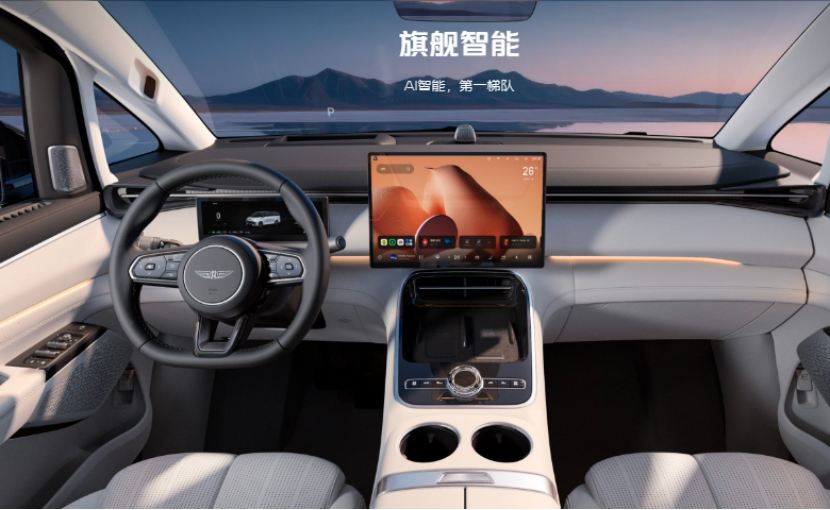
Its chances appear credible. While the existing order remains powerful, the deepening wave of intelligent mobility, rising penetration of new-energy MPVs and a clear shift towards value-based consumer judgement create a window of opportunity. Supported by Geely’s technological depth and distribution network, the Galaxy V900 possesses the core conditions for a potential breakthrough.
Whether it can ultimately reshape the market, however, will depend on execution, long-term quality control and the verdict of consumers. The contest has only just begun.